

Views: 0 Author: Site Editor Publish Time: 2026-03-27 Origin: Site


Water-based adhesives are widely adopted across industries because they support cleaner production, lower emissions, and easier handling. Yet many users quickly realize that environmental advantages alone are not enough. Adhesives must also meet demanding performance requirements such as water resistance, heat stability, and long-term bonding strength. This is where a water-based adhesive crosslinking agent becomes essential. It acts as a functional upgrade within the adhesive system, helping manufacturers achieve stronger and more reliable results without sacrificing the benefits of water-based formulations. At Yoho Chemical, with extensive experience in water-based adhesive development and large-scale production, we focus on providing crosslinking solutions that enhance performance while remaining practical for industrial use.
At a fundamental level, a water-based adhesive crosslinking agent connects individual polymer chains within the adhesive. These connections form chemical bridges that strengthen the internal structure of the adhesive film.
Without crosslinking, polymer chains are loosely arranged and can move relatively freely. This limits the adhesive’s ability to resist stress, moisture, and temperature changes. Once a crosslinking agent is introduced, the chains become interconnected, forming a stronger and more stable network.
This transformation is not just a chemical change but a structural one. It directly influences how the adhesive behaves during application and throughout its service life.
When crosslinking occurs, the adhesive develops a three-dimensional network structure. This network restricts the movement of polymer chains, making the adhesive more resistant to deformation and environmental factors.
The result is improved mechanical strength, better resistance to water and heat, and enhanced durability. The adhesive becomes less likely to soften under heat or weaken when exposed to moisture.
This structural improvement is especially valuable in applications where adhesives must perform under challenging conditions, such as packaging, labeling, and industrial bonding.
Water-based adhesives are naturally more sensitive to moisture than solvent-based systems. Without modification, they may absorb water and lose bonding strength.
A water-based adhesive crosslinking agent improves water resistance by reinforcing the internal structure of the adhesive. This prevents water from penetrating and weakening the bond.
Heat resistance is also enhanced. Crosslinked adhesives can maintain their strength at higher temperatures, reducing the risk of failure in applications exposed to heat.
These improvements allow water-based adhesives to compete with or even replace solvent-based systems in many applications.
Cohesion refers to the internal strength of the adhesive itself. A lack of cohesion can lead to failure even when the adhesive initially bonds well to the substrate.
Crosslinking increases cohesion by strengthening the connections between polymer chains. This results in a more durable adhesive that can withstand mechanical stress and environmental exposure.
Long-term stability is particularly important in industries such as packaging and electronics, where adhesive performance must remain consistent over time. Crosslinking ensures that the adhesive maintains its properties throughout its lifecycle.
Pressure sensitive adhesives are one of the most common applications for water-based crosslinking agents. These adhesives are used in labels, tapes, and protective films, where consistent performance is critical.
Crosslinking improves resistance to temperature changes and environmental conditions. It also enhances the adhesive’s ability to maintain its properties under pressure and repeated use.
In general adhesive systems, crosslinking agents are used to improve bonding strength and durability. This includes applications in packaging, laminating, and assembly processes.
The benefits of crosslinking are not limited to adhesives. Similar principles apply to coatings such as varnishes, paints, and inks.
In these systems, crosslinking improves film hardness, chemical resistance, and durability. This makes the final product more resistant to wear and environmental damage.
The versatility of water-based crosslinking agents allows them to be used across multiple industries, providing consistent performance improvements.
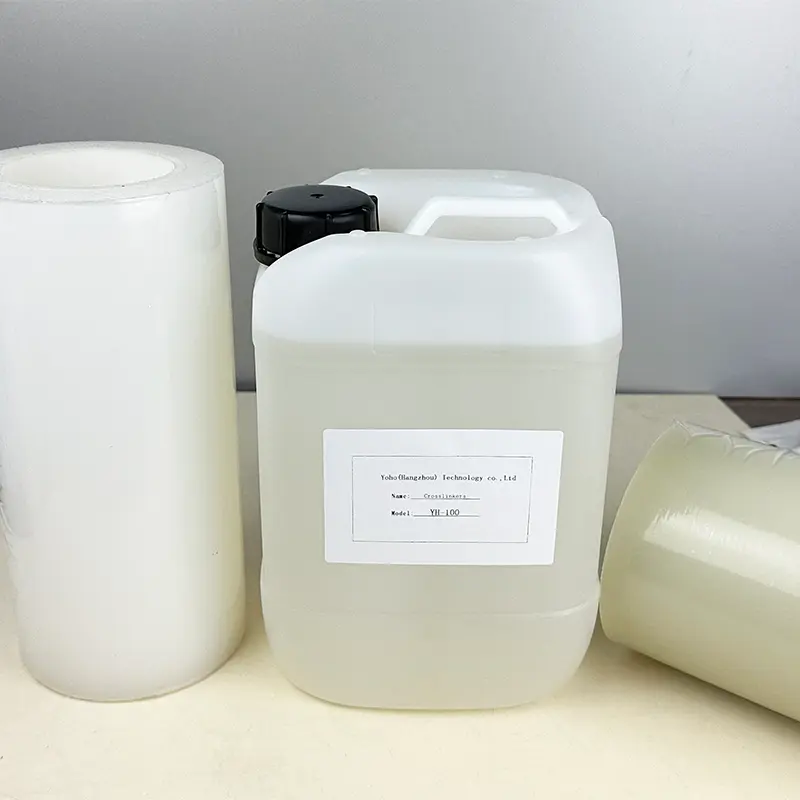
Many manufacturers have shifted to water-based systems to meet environmental regulations and reduce emissions. However, performance limitations can be a concern.
A water-based adhesive crosslinking agent provides a way to enhance performance without reverting to solvent-based formulations. This allows manufacturers to maintain environmental compliance while achieving high-performance results.
This approach aligns with global trends toward sustainable manufacturing and greener production processes.
Water-based adhesives are valued for their ease of application and handling. Crosslinking enhances these systems without significantly increasing complexity.
The result is a balanced solution that combines strong bonding performance with operational efficiency. This balance is particularly important in large-scale production environments where consistency and ease of use are critical.
Use Scenario | Before Crosslinking | After Crosslinking | Business Value |
Packaging Adhesives | Weak moisture resistance | Improved water resistance | Reduced product damage |
Label Adhesives | Limited heat tolerance | Higher heat resistance | Stable performance in transport |
Laminating Systems | Lower cohesion | Stronger bonding strength | Improved product reliability |
Industrial Coatings | Softer films | Harder, more durable films | Extended service life |
Proper usage is essential for achieving the desired performance improvements. Crosslinking agents are typically added in small amounts, but the exact dosage must be carefully controlled.
The pH of the adhesive system also affects crosslinking efficiency. Maintaining the correct pH ensures that the reaction proceeds effectively, leading to optimal performance.
Incorrect dosage or pH can reduce the effectiveness of the crosslinking process, resulting in suboptimal adhesive properties.
Once a crosslinking agent is added to an adhesive system, the mixture has a limited working time. This period, known as pot life, is critical for processing.
During pot life, the adhesive must be applied before the crosslinking reaction progresses too far. Proper mixing sequence ensures that the crosslinker is evenly distributed throughout the system.
Managing pot life and mixing conditions helps prevent issues such as uneven performance or premature curing.
Compatibility between the crosslinking agent and the adhesive system is essential. The chemical structure of the crosslinker must match the functional groups in the polymer.
A compatible system ensures efficient crosslinking and stable performance. Incompatible combinations may lead to instability or reduced effectiveness.
Testing is often required to confirm compatibility before large-scale production.
Some crosslinking systems can function effectively at room temperature, while others require elevated temperatures to achieve optimal results.
Heat can accelerate the crosslinking reaction, improving performance. Understanding the processing conditions helps users select the right crosslinking agent for their application.
Practical factors such as handling and safety are important considerations in industrial environments. A well-designed crosslinking agent should be easy to use and safe to handle.
Low odor and user-friendly properties improve working conditions and reduce operational challenges.
Consistency is a key factor in adhesive performance. A crosslinking agent must perform reliably under real production conditions, not just in laboratory tests.
At Yoho Chemical, we focus on developing products that deliver consistent results across different processing environments, helping customers maintain quality and efficiency.
Improving adhesive performance is not only about selecting the right base polymer but also about strengthening its internal structure. A water-based adhesive crosslinking agent enables water-based systems to achieve higher durability, better resistance, and more stable performance in demanding applications. At Yoho Chemical, our expertise in water-based adhesives and crosslinking technologies allows us to provide solutions that meet both performance and sustainability goals. With a strong technical team and large-scale production capacity, we support customers across packaging, electronics, and industrial applications. If you are looking to upgrade your adhesive systems or improve product reliability, contact us to learn how our crosslinking solutions can support your business. Integrating an effective waterborne adhesive crosslinking solution is a practical step toward achieving stronger, more durable, and more competitive products.
1. What is a water-based adhesive crosslinking agent used for?
It is used to improve adhesive properties such as water resistance, heat resistance, and bonding strength.
2. How does crosslinking improve adhesive durability?
It creates a network structure within the adhesive, increasing cohesion and resistance to environmental stress.
3. Can crosslinking agents be used in all water-based systems?
Compatibility depends on the polymer structure, so testing is necessary to ensure proper performance.
4. What factors affect crosslinking efficiency?
Dosage, pH, mixing sequence, and processing conditions all influence the effectiveness of the crosslinking process.


