

Views: 0 Author: Site Editor Publish Time: 2026-04-01 Origin: Site


Understanding what is inside a chemical product often determines how confidently it can be used in production. When a crosslinker is described as a two-component system, buyers are not just asking about ingredients—they want to know how those components influence mixing behavior, working time, and final performance. A water-based adhesive crosslinking agent is not a simple additive but a carefully structured system designed to interact with waterborne polymers and enhance their performance in real applications. At Yoho Chemical, supported by a professional R&D team and a production base with large-scale capacity, we focus on designing crosslinking systems that combine stability, efficiency, and practical usability for industrial adhesive applications.
The composition of a crosslinking agent directly controls how it behaves both before and after use. During storage, the product must remain stable, avoiding premature reactions that could reduce effectiveness. During application, it must quickly activate and react with the adhesive system.
This dual requirement creates a need for carefully balanced formulation design. Reactive components must remain inactive under storage conditions but become highly effective once introduced into the adhesive. Supporting components such as stabilizers and carriers help maintain this balance.
The ability to control reactivity is what allows manufacturers to use the product efficiently without worrying about unpredictable performance or reduced shelf life.
Many products in the market are described in similar terms, yet their actual performance can vary significantly. This is because the internal composition, including the type and concentration of reactive groups, can differ.
Two crosslinkers may both be labeled as suitable for water-based adhesives, but their reaction speed, compatibility, and final performance can be completely different. Understanding composition helps users avoid unexpected results and select a product that truly fits their application.
The most important part of a water-based adhesive crosslinking agent is its reactive component. This component is designed to interact with functional groups present in water-based adhesives, particularly carboxyl groups.
When these interactions occur, chemical bonds are formed between polymer chains. This process strengthens the internal structure of the adhesive, improving its ability to resist water, heat, and mechanical stress.
The effectiveness of this reaction depends on how well the reactive component matches the adhesive system. A well-matched system ensures efficient crosslinking and consistent performance.
Crosslink density refers to how many connections are formed between polymer chains. This factor has a direct impact on the final properties of the adhesive.
A higher crosslink density generally leads to stronger, more durable films with improved resistance to water and heat. However, excessive crosslinking can reduce flexibility, making the adhesive too rigid for certain applications.
Balancing crosslink density is therefore essential. The composition must be carefully designed to achieve the desired level of performance without compromising usability.
Two-component systems are commonly used to improve product stability. By separating reactive components, the crosslinker can be stored safely without risk of premature reaction.
This design extends shelf life and ensures that the product remains effective until it is needed. It also allows manufacturers to maintain consistent quality across different batches.
Before use, the components are combined to create an active system. This pre-mixing step helps ensure that the crosslinker is evenly distributed when added to the adhesive.
Uniform dispersion is critical for consistent performance. If the crosslinker is not evenly distributed, some areas of the adhesive may not achieve sufficient crosslinking, leading to weaker bonds.
Pre-mixing also helps activate the reactive components, preparing them for efficient interaction with the adhesive system.
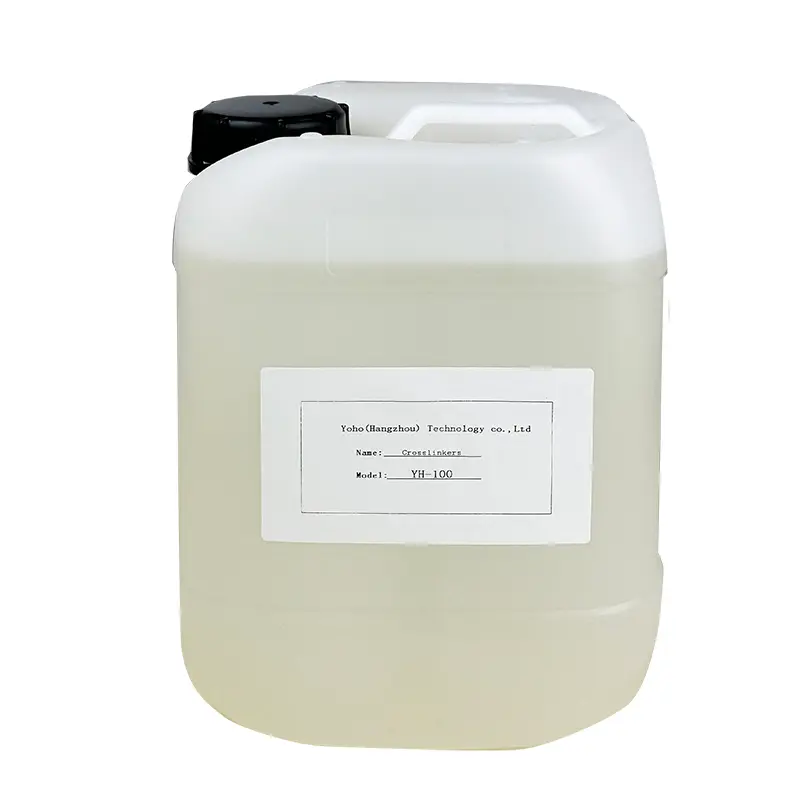
Water plays an important role in improving compatibility between the crosslinker and the adhesive. Pre-diluting the crosslinker with water can make it easier to mix with the adhesive system.
This step reduces differences in viscosity and helps achieve a more uniform distribution. It also allows for more precise control during the mixing process.
Improved miscibility leads to better performance and fewer processing issues.
The order in which components are added can significantly influence the final result. Adding the crosslinker in the correct sequence ensures that it is evenly distributed throughout the adhesive.
Improper mixing can lead to localized reactions or uneven crosslinking. This can affect both performance and appearance.
Careful control of the mixing process helps ensure consistent results in large-scale production.
Once the crosslinker is added to the adhesive, the reaction begins. Over time, this can lead to gelation, where the adhesive becomes too thick or difficult to use.
This behavior is directly related to the composition of the crosslinker. More reactive systems may have shorter pot life, requiring faster processing.
Understanding this characteristic helps users plan their operations and avoid waste.
Managing pot life is essential for efficient production. The adhesive must be used within a specific time frame to ensure optimal performance.
This requires coordination between mixing, application, and curing processes. Proper planning helps prevent issues such as premature curing or uneven performance.
In industrial environments, effective pot life management can significantly improve productivity and reduce costs.
Composition Element | Main Job | Impact on Performance | Practical Note |
Reactive Component | Forms crosslinks | Improves strength and durability | Must match adhesive system |
Stabilizer | Maintains product stability | Prevents premature reaction | Extends shelf life |
Water/Carrier Phase | Enhances dispersion | Ensures uniform mixing | Often used in pre-dilution |
Additives | Improve handling | Enhance usability and safety | Affects processing efficiency |
The composition of the crosslinking agent determines how well the adhesive performs under different conditions. A well-designed system improves resistance to water and heat, allowing the adhesive to maintain its strength even in demanding environments.
Film strength is also enhanced. The crosslinked network provides a more robust structure that can withstand mechanical stress and environmental exposure.
These improvements are essential for applications where reliability is critical.
Crosslinking enhances both adhesion and cohesion. Adhesion refers to the bond between the adhesive and the substrate, while cohesion refers to the internal strength of the adhesive.
A balanced composition ensures that both properties are optimized. This leads to better long-term performance and reduced risk of failure.
Reliability over time is a key factor in many applications, including packaging, electronics, and industrial assembly.
When selecting a crosslinking agent, buyers should consider how it will be used in their specific application. This includes recommended dosage levels, pH requirements, and curing conditions.
These factors influence how effectively the crosslinker performs and how easily it can be integrated into existing processes.
Understanding these details helps ensure successful implementation.
Safety and compatibility are also important considerations. The crosslinking agent should be easy to handle and compatible with the adhesive system.
At Yoho Chemical, we design our products to meet these requirements, providing solutions that are both effective and practical for industrial use.
Composition is the foundation of performance in any chemical system. A water-based adhesive crosslinking agent is carefully engineered to balance reactivity, stability, and usability, ensuring that it delivers consistent results in real production environments. At Yoho Chemical, our experience in water-based adhesive technology allows us to develop crosslinking solutions that support a wide range of applications while maintaining efficiency and sustainability. With strong technical support and large-scale manufacturing capabilities, we help customers achieve better adhesive performance and more reliable production outcomes. If you are looking to optimize your adhesive formulations or improve process control, contact us to learn more about how our solutions can support your needs. Selecting the right waterborne adhesive crosslinking system is a key step toward achieving stronger, more durable, and more efficient adhesive performance.
1. What is included in a water-based adhesive crosslinking agent?
It includes reactive components, stabilizers, and additives designed to enhance adhesive performance and maintain stability.
2. Why is a two-component system used?
It improves storage stability and allows controlled activation during application.
3. How does composition affect pot life?
The composition determines how quickly the crosslinking reaction occurs, which affects working time.
4. Can composition impact final adhesive performance?
Yes, it directly influences water resistance, heat resistance, and bonding strength.


